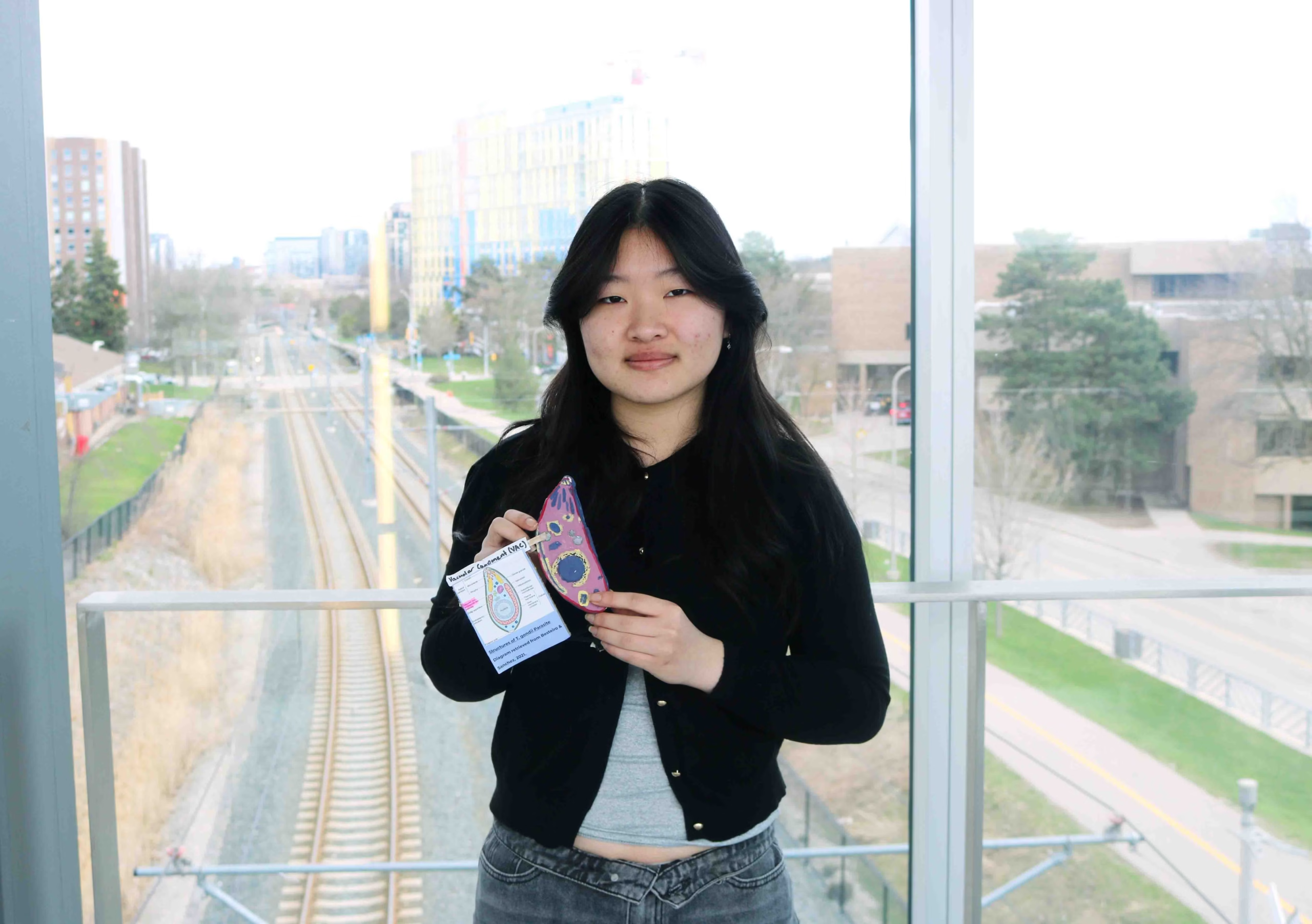


Emily Huang, a grade 12 Laurel Heights Secondary School student, was selected as one of eight students to represent Canada at the upcoming Regeneron International Science and Engineering Fair (ISEF), taking place in Phoenix, Arizona, from May 9 to 15, 2026.
On Mar. 23, 2026, Youth Science Canada (YSC), a national organization dedicated to supporting young Canadians in STEM, announced that eight students had been selected to represent the country at ISEF, the world’s leading youth STEM competition. Huang noted that representing the country alongside her peers is a significant milestone.
“It’s a huge honour to be able to represent Canada on the international stage alongside seven of Canada’s other top young scientists,” she said. “The team this year for ISEF, we’re all super diverse—we’re all in different grades, we come from different parts of Canada, and we have super different projects. I think that diversity is one of our biggest strengths here in Canada.”
The candidate—including Huang and seven other top young scientists from across the country—were identified at the 2025 Canada-Wide Science Fair (CWSF) and have since participated in a YSC-led development program focused on competition readiness and effective communication.
“The structure of the competition itself—the awards, the scholarships, the special prizes—is administered by the Society for Science, which runs ISEF,” Dalia Esposito, Account Manager at Torchia Communications, said.
According YSC, participants present their work to expert judges alongside nearly 2,000 students from over 60 countries. The organization noted that this environment subjects students to rigorous scientific scrutiny regarding their methodology and conclusions.
“That kind of pressure builds a clarity of thinking and a confidence in communicating science that is hard to develop any other way,” Esposito said on behalf of YSC.
Huang’s project, Evaluating and Improving In Silico Drug Candidate Prediction for Chronic Toxoplasma gondii Infection, utilizes computational modelling to address drug candidate evaluation for chronic infections. Despite the project’s success, Huang faced significant technical hurdles during its development.
“One of my biggest challenges with this project is just the lack of current open-source data available online for the specific disease that I’m focusing on, toxoplasmosis,” Huang said. She noted that this forced her to explore alternative techniques, such as creating synthetic data sets, to train her models.
In an era of rising AI prevalence, Huang emphasizes that human intuition remains the driving force behind the data.
“The aim of my project is to identify the specific features and substructures that an AI model focuses heavily on,” Huang explained. “Being able to still think critically and actually fully evaluate how a model is making its predictions is something that’s super important to consider when you’re doing something like drug discovery, where you have the potential to impact a lot of human lives.”
YSC echoed this sentiment, noting that computational tools are strictly in service of scientific questions.
“AI is a tool and, like any tool, it doesn’t generate the question, define the problem, or evaluate whether the answer actually makes sense,” Marc Roussel, YSC’s National Judge-In-Chief and chair of the selection panel, said in a written statement.
Roussel indicated that the 2026 delegation stands out for its combination of sophistication and clarity of purpose.
“We’re looking for more than impressive results. We want to select students who have asked a meaningful question and pursued it with integrity,” he said.
Huang’s selection reflects the ongoing STEM activity within the Waterloo region. Her path to Phoenix involved advancing through a regional fair to the CWSF. YSC described Huang’s work as an example of a student pursuing a scientific question beyond standard coursework requirements, identifying a meaningful gap in how drug candidates are evaluated for difficult chronic infections. To navigate this complex process, Huang relied on a national support system.
“Youth Science Canada, through this whole process, they’ve been really great and super supportive,” she said, noting that they connected her with her project mentor, Dr. Brent Dixon at Health Canada. “Overall, just being able to connect with people from across Canada and learn from people in the field, it’s been a really rewarding experience.”
Huang attributes much of her success to growing up in Waterloo’s tech triangle. Being exposed to STEM through University of Waterloo outreach programs and local science fairs inspired her from an early age.
“Through those opportunities, I’ve been able to really explore my passions and interests in a way that maybe I wouldn’t have been able to if I were to live somewhere else,” Huang said.
As the delegation prepares for Phoenix, Huang’s advice to future scientists is to lead with passion.
“It doesn’t have to be the most fancy topic ever. But if you have a topic that you’re really passionate about, it’ll encourage you to actually stick through it and see it through to the end,” Huang said.
The next cycle of the national STEM network will continue this May as 400 students gather in Edmonton for the 2026 CWSF.

Leave a Reply