
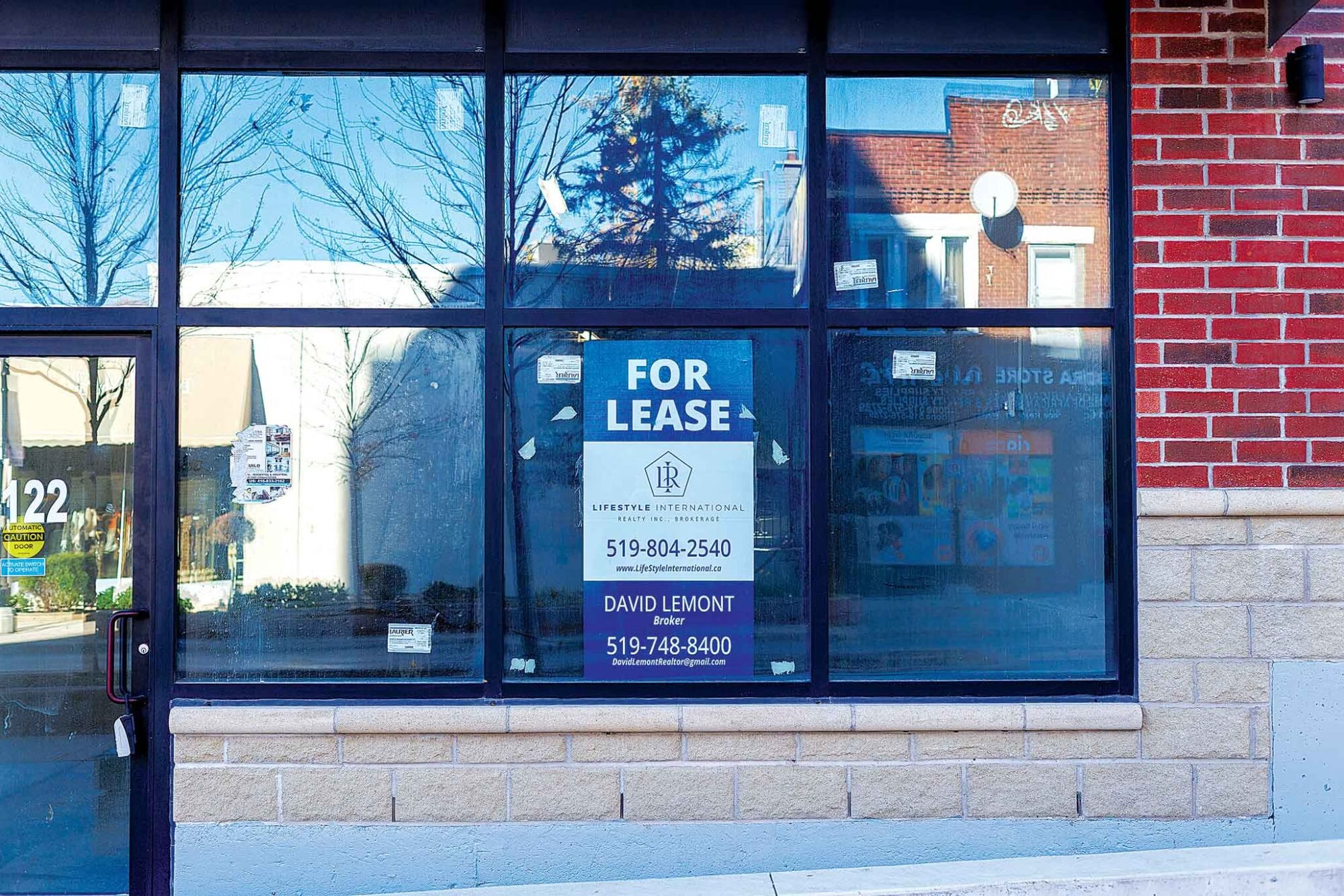
Even as Waterloo Region’s tech workforce continues to grow, commercial vacancy rates in Kitchener and Waterloo remain higher than the national average. The latest data from commercial real estate firm CBRE reported a 17.6 per cent vacancy rate across the region and a 30 per cent vacancy rate in the downtown cores. The national average vacancy rate is 13.6 per cent.
While city and business leaders focus on attracting tenants to these spaces, there is an equal effort to attract more businesses to ground-floor retail spaces in mixed-use buildings along the ION light rail system. But including ground-floor retail spaces in a project does not mean it will be leased, said Chris Kotseff, Executive Vice President at JLL Canada.
“My opinion is that this market is tricky for mixed use, period. The viability of leasing or selling ground-floor space is a derivative of the neighbourhood and its walkability,” Kotseff said.
Understanding why some spaces remain vacant comes down to the classic adage: location, location, location. Outside of specific streets within ION light rail station areas in Kitchener and Waterloo, commercial spaces are not required as part of a planning application. Site-specific provisions can waive or add the requirement on a case-by-case basis.
“In this market, yes, we have transit, we have the LRT, and they’re great. But a lot of people still use their cars. So, for mixed use to be successful, you need a large pool of permanent residents, and that means office, so you have daytime traffic, and residential, so you have morning and evening traffic as well. If you don’t have enough scale or mass, it doesn’t seem to work very well,” Kotseff said.
One example of a project that has succeeded is the Bauer Building on King St. in Waterloo. In 2010, the former Bauer automotive products manufacturing site was converted into a mixed-use development with commercial, residential and retail spaces.
“That development works really well because it checks all the boxes. It’s in a neighbourhood with really strong walkability. There’s a community that walks because Uptown has that to offer. It’s right on transit for the people who get around that way, and it has parking for those who don’t. People going to Bauer Kitchen or Vincenzo’s don’t have to question it. They can get in their car knowing there’s parking—underground, on the street or a surface lot. There’s always somewhere to park,” Kotseff said.
While some newer projects with ground-floor retail are attracting tenants, others remain vacant for months, even years. Ryan Kaitting, Senior Vice President at Cushman & Wakefield Waterloo Region Ltd., said another challenge in finding tenants is that many of the spaces are not designed or engineered correctly for retail or restaurant businesses.
According to Kaitting, most developers deliver the right-sized space, but they don’t provide the build-out – electrical service, HVAC, plumbing and drywall—to support the uses they want in their spaces.
“A lot of them say, ‘We want a restaurant.’ Okay, in an area saturated with restaurants, you want someone to build out from scratch? It’s also 2026, and hospitality has taken a big kick over the last couple of years,” he said.
One restaurant that has found success in a mixed-use project is the Humble Lotus. The take-out and delivery focused sushi spot is one of two businesses on the ground floor of the Market Flats at 388 King St. E. in Kitchener.
Co-owner My Nguyen said she and partner Jared Wood chose the space in 2022 based on its size, on-street parking and the growth potential in the neighbourhood. Opening near the end of the pandemic meant they could not depend on office traffic, so they opted for a smaller space in an underdeveloped part of the city. Today, they’re surrounded by new residential buildings and businesses.
“These vertical communities, as we call them, need places to go too, so the overspill onto the street will be great. The key is for businesses to sustain until we get there,” she said.
Wood, Humble Lotus’s co-owner and Nguyen’s husband, lives just a few blocks from the restaurant. Initially, he wanted to find a space in Waterloo, but said Nguyen wanted to create something that would be part of their neighbourhood.
“The whole reason we picked this space is that this is our community. If we can make it in our community, we can make it anywhere. That’s the whole reason we’re here,” Wood said.


Leave a Reply