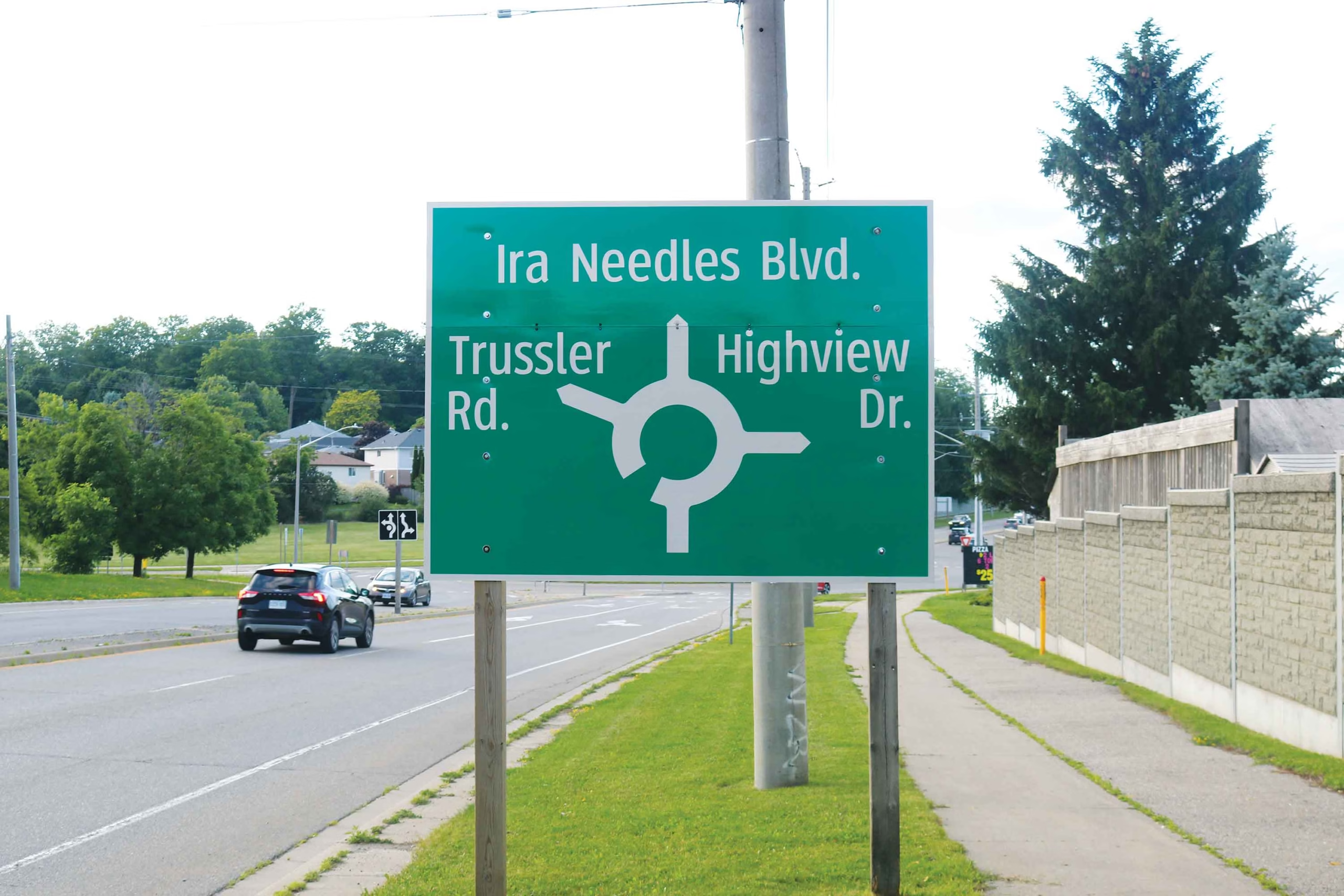




On June 4, 2026, the Canadian Automobile Association (CAA) named Ira Needles Blvd. in Waterloo the worst road in Western Ontario. Marking the fourth consecutive year the boulevard has held the top spot, the ranking follows widespread driver criticism regarding crumbling infrastructure, including potholes and uneven pavement, as well as persistent traffic congestion.
The ranking was the outcome of the CAA’s annual Worst Roads campaign, an initiative now in its 20th year. Brian Pirvu, a Government Relations Consultant for CAA South Central Ontario, said the campaign serves as a vital tool for bridging the communication gap between frustrated residents and municipal decision-makers.
“We serve this as a way to give road users the opportunity to voice their concerns,” Pirvu said. “Once the campaign concludes, we then begin or continue conversations with municipalities to look for opportunities to prioritize some of the roads that are up on our list.”
Campaign critics sometimes dismiss the results as a popularity contest or a platform for disgruntled venting. However, Pirvu said that the CAA employs a rigorous vetting process.
The organization partners with the Residential and Civil Construction Alliance of Ontario (RCCAO), whose members conduct independent analyses to ensure that the road issues—such as potholes, uneven pavement or traffic congestion—are technically accurate and relevant to the streets nominated.
Kitchener Ward 7 Councillor Bil Ioannidis said the road’s persistent presence on the list is a direct reflection of its role as a high-traffic artery that has fundamentally outgrown its original design.
“It has access to a lot of shopping, and it has heavy use. It’s not surprising to me that it’s one of the worst roads with regard to the issues that have been raised,” Ioannidis said.
Ioannidis pointed to historical planning errors as the root of the problem. When Ira Needles Blvd. was first integrated, the region opted for a design that underestimated future volume.
“They just didn’t do the proper pavement work that was needed for the amount of volume that was anticipated,” Ioannidis said. “They kind of did a sort of patchwork to raise the volume of traffic.”
The road’s status is further complicated by jurisdictional boundaries. Because Ira Needles acts as a continuous artery for various municipalities and feeds into regional infrastructure, coordinating long-term fixes often requires navigating multiple layers of bureaucracy, including the Ministry of Transportation and the Region of Waterloo.
“We wait on different timelines from different municipalities to get things done,” Ioannidis said. “I try to coordinate it so it’s more efficient at one time, rather than doing part of the work and then having someone come in a year or two later. It’s all better constructed under one project rather than several.”
The Region of Waterloo has acknowledged these concerns. In a recent statement, the Region noted that the decision to prioritize Ira Needles Blvd. for reconstruction reflects the road’s deteriorating state.
“Ira Needles is a major corridor used by nearly 34,000 vehicles a day, including transit and goods movement, so keeping it safe and reliable is a priority,” the statement said. “Resurfacing the road now is expected to cost less over time than continuing with repeated patching and will extend the road’s life until full rehabilitation is needed.”
Beyond asphalt, the campaign is also highlighting a shift in how residents view and understand road safety. Pirvu noted that the campaign has evolved since 2003, moving from a pothole focus to include pedestrian and cycling infrastructure.
“We’ve seen traffic congestion become a more dominant issue and we’ve seen road safety concerns being mentioned as well,” Pirvu said. “There is more emphasis on pedestrian and cycling infrastructure safety.”
While Ioannidis acknowledged that roundabouts and intersections on the route remain challenging for cyclists and pedestrians, he expressed hope that current pilot projects would lead to better integration. As the region gears up for summer construction, the CAA remains optimistic that this Worst Road designation will serve as the final catalyst for much-needed funding.
“We’ve seen municipalities respond,” Pirvu said. “We know that they are aware that these roads need attention, and we’re just looking to give an alternative snapshot or a friendly reminder that people are concerned.”

Leave a Reply