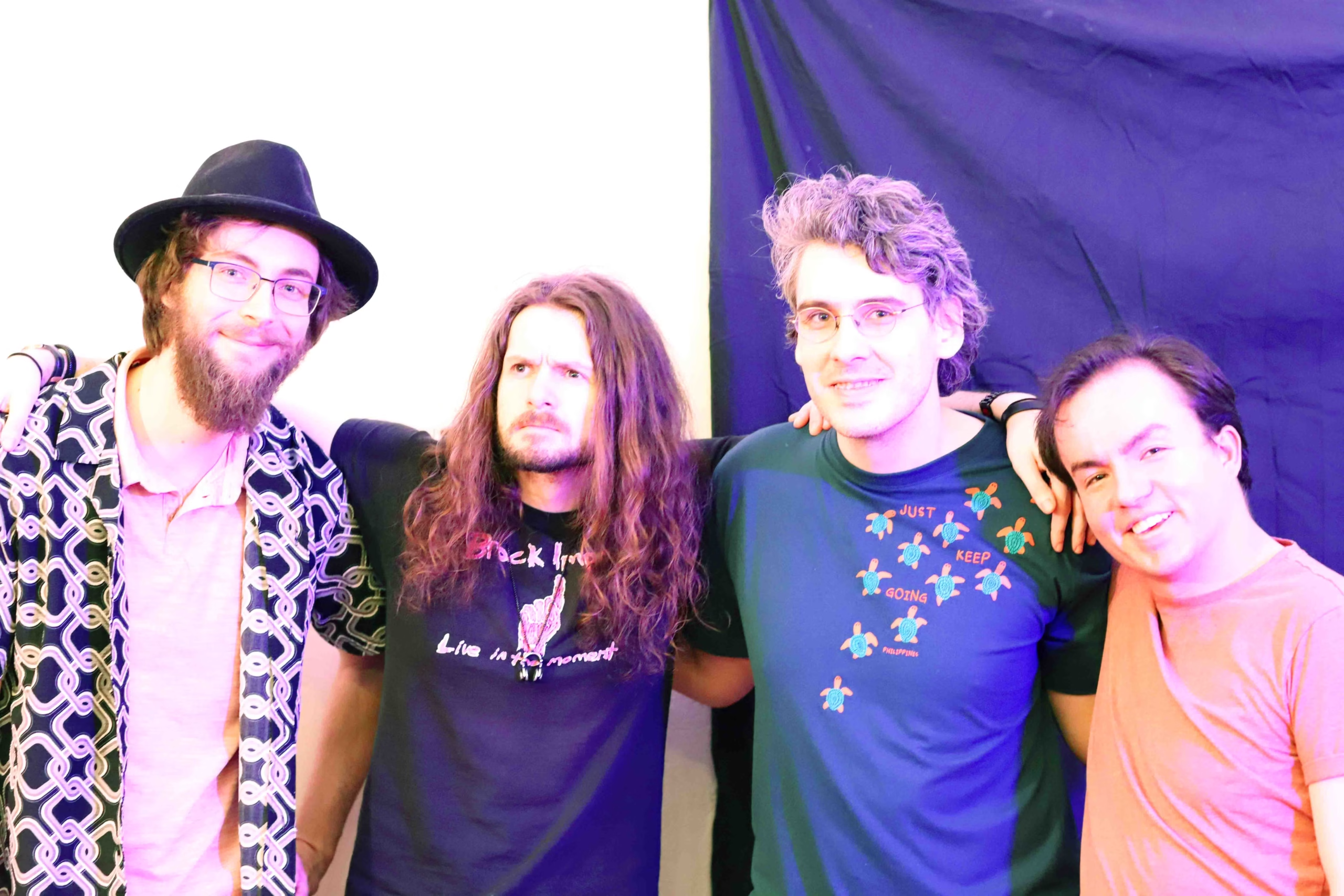




Your Improv Journey is Paul Drotos’ treatise meant for beginners, veterans and randos. It is an easy read and is relevant even when considering teamwork, community and art in general.
Improv is an art form where actors create scenes on the spot. In a show, troupes will usually have games they play with varying levels of audience input.
When the scene ends, that is the end of that piece of improv. Even if recorded, Drotos says that is a recorded sketch and no longer an improv scene.
“Improv is unique in that its creations instantly disappear—once it has concluded, it ceases to exist, never to reappear,” the book reads. “Given this, the only real way that improv…can exist is in groups of people agreeing to make something up together.”
Your Improv Journey begins at the beginning with practical advice on starting your improv journey—from classes and jams to creating and/or joining troupes. From the start, there is a focus on making improv accessible and lowering barriers.
After this, however, Drotos moves on to critically analyzing what it means to be an improviser.
Drotos discusses more specific topics such as offensive humour—which is, according to them, very easily exhaustible and exhausting—elitism, privilege, perfectionism, the audience-artist relationship, imposter syndrome, accessibility and more.
They highlight the importance of empathy from and for everyone involved including audience. Part of this is recognizing one’s own privilege, but not getting too caught up in it.
“The best improvisers are curious and empathetic people, and they constantly seek out new opportunities and interesting different experiences,” the book reads. “It’s how we communicate.”
Drotos lived around the Niagara region until 2019, but moved to Waterloo Region with their friend and improv teammate Luke Webster on a whim. Here, they founded Afterschool Arcade with additional teammates Darel Dean, Drew Hobden and Leslie Wilkinson, who joined for a short time.
As they emphasized in the book, Drotos believes in focusing on improv as an art and a hobby, not primarily as a means of making money. Your Improv Journey has, since its publication in May 2025, made a few hundred dollars. They also work as a sound designer in the video game industry.
“I don’t [make much money]—that’s really the answer. I live very, what I like to call, ‘cash poor, experience rich’…It’s not a money driven endeavour,” they said.
“I don’t like it when improv troupes think, ‘oh, to be a real improviser, you need to teach classes,’ because…the invisible message there is, the goal of improv is to make money,” Drotos said.
Drotos said there is no end to the journey of becoming an improviser. Believing there was an end was, according to them, their biggest failure as an improviser.
“I think I mentioned that the only way to fail is to think that you would have completely succeeded and don’t need to grow anymore…that was the biggest way that I had failed,” Drotos said.
“I had fooled myself into thinking that I’d come to the end of my journey and that I had made it and I’d become an improviser—and that was the period where I was learning the least about working with other people, and it was probably the period of time where I was the most intolerable to work with,” they said.
Improv is ultimately dependent on teamwork—in the book, Drotos places much emphasis on the importance of working with others.
Drotos states that teamwork is vital—improv artists must recognize that what they can create together will be better than what any one person can create on their own.
“The personal pursuit of perfection is doomed from the start, because you are not the only person there,” the book reads.
“[F]ailing at improv is one of those things where, if you stop listening and you stop supporting other people, you’re not really doing improv,” they said.
It was surprising how much insight this book provides on the nature of teamwork. In hindsight, it makes sense, since improv scenes depend on teamwork both between the members of the troupe and the audience.
The book is not irreverent, but is very self-aware. When talking about offensive humour, Drotos talks also about their ego, which demands better work from them.
“My ego and pride are an inherent part of me, and make sure I don’t pick the lowest-hanging fruit,” they write.
While this is technically a work on Improv Theory, Drotos does highlight that experience and personal convictions can be more important than the theory. And not everyone needs a theory behind their improv.
“Theory is nice when it helps you to grasp concepts you wouldn’t have otherwise, but it’s not necessary to know theory in order to be a good improviser…Improv certainly comes from between the ears, but it can’t stay there,” the book reads.
“Because if you read or listen to the theory, and you go, that that’s not true. You now have yourself a truth that you can work with for your improv. So, theory is not necessary,” Drotos said.
In getting to the point of being somewhat of an authority on improv, Drotos acknowledged their own privilege as well as what they describe as “survivor’s guilt”—the feeling that other capable improv artists were, perhaps, more deserving. Their solution is to consider the responsibility that comes with holding a privileged position.
“It’s also important to know what your advantages and privileges are, and how temporary they are,” they write.
“It’s a survivor’s guilt more than anything. I cope with it by knowing that like these privileges and opportunities happen randomly…I also cope by trying to make as many opportunities for others as possible in a kind of pay-it-forward way,” Drotos said.
The tone of this book is conversational and accessible, making it an easy read. Drotos is funny, but also makes serious points with appropriate weight.
However, as in conversations, the points made are sometimes repetitive.
Overall, however, even though I am not interested in pursuing improv either as a career or as a hobby, this was a valuable read. For me, the insights on teamwork and empathy, as well as Drotos’ engagement with theory were both well-articulated and fresh.
Their perspective on how theory should be used—not as a whip, but as a kitchen knife—is refreshing, as is their focus on constant evolution.
“Do your best to remember that you won’t always be improving, but you’ll always be growing and changing. The two aren’t synonymous, and a lack of one doesn’t necessarily mean a lack of the other,” Drotos writes.

Leave a Reply